EnglishFrenchGermanSpainItalianDutchRussianPortugueseJapaneseKoreanArabicChinese Simplified
Showing posts with label exhibitions. Show all posts

Saturday, February 11, 2012

The World of Kato Kunio


Hachioji Yume Art Museum Special Exhibition: The World of Kato Kunio
八王子市夢美術館特別展 加藤久仁生展
Hachioji Yume Art Museum
10 February – 25 March 2012

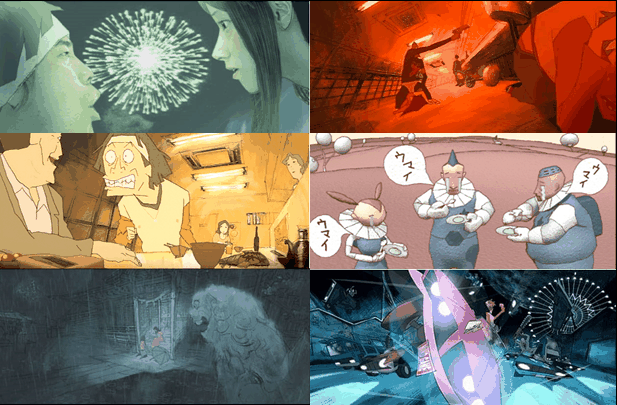
On Friday, the Hachioji Yume Art Museum launched itsspecial exhibition celebrating the career so far of Oscar-winning animator Kunio Katō (加藤久仁生, b. 1977).  Since winning the Oscar for Best AnimatedShort Film for La maison en petits cubes(つみきのいえ/Tsumiki no ie, 2008), Katō has keep arelatively low profile internationally. He has; however, indeed kept busy creating an animation campaign incelebration of the 40th anniversary of Sekisui Heim (セキスイハイム) among other projects for his company ROBOT.  There have recentlybeen rumours that Katō may be involved in the production of the animatedadaptation of Khalil Gibran’s poetry collection The Prophet (Roger Allers, Sylvain Chomet, et al., 2013).

still from Sekisui Heim animated CM

A graduate of Tama Art University,where Katō was introduced to animation by the influential animator MasahiroKatayama, Katō quickly became the darling of Japan’s indie animation scenewith his short films TheApple Incident (2001), Fantasy(2003) and his web series TheDiary of Tortov Roddle (2004). Before winning the Oscar, he had already been the recipient of manylaurels including twice winning the YuriNorstein Prize at Laputa as well as top awards at international festivals including the Japan Media Arts Festival, Hiroshima, and Annecy.

The exhibition, which was puttogether in collaboration with the designer Makoto Koizumi (小泉誠), features sketches, storyboards,and original illustrations from the production of La maison en petits cubes. One can follow the production process step-by-step and learn about howthis exceptional animated short came to life. In addition, the exhibition features work Kato has done since winningthe Oscar – sketches from Atogaki (あとがき/Postscript) a regular feature by Kato published in the animation magazine MOE.


 The highlight of the exhibition is Katō’slatest animated short  Jōkei(情景, 2012) which he made especially for this event.  In addition, Kenji Kondo, the composer of the La maison en petits cubes soundtrack, and the Kuricorder Quartet (栗コーダーカルテット) will perform music from the film atnearby Ichō Hall onFebruary 16th


For more information and a slideshowof images from the event, go to Yumebi.com(JP only).

Hachioji Yume ArtMuseum                                                                                                                   
2F View Tower Hachiouji
 8-1 Youkamachi, Hachioujishi
Tokyo 192-0071
Tel. 0426-21-6777 Fax 0426-21-6776
10:00-19:00
For directions to the event see Tokyo Art Beat (EN/JP)

Saturday, August 27, 2011

Japan in Germany 4: Japan Media Arts Festival Dortmund


The Japan Media Arts Festival has been held annually in Tokyo since 1997.  Sponsored by the Agency for Cultural Affairs, the festival aims to promote the development of innovative media arts.  They accept entries from all over the world and award prizes in four creative divisions: Art, Animation, Entertainment, and Manga.  Last year they had a total of 2,645 works entered into the competition including 694 from overseas.  Check out their website for their current call for entries.  

Dortmund U is hosting a selection of the best of the Japan Media Arts Festival this fall from September 9th until October 2nd, 2011.  The event has been curated by Stefan Riekeles (Les Jardins des Pilotes, Berlin).  The Exhibition itself will be open daily except for Mondays:

Tuesday - Wednesday 10:00 -18:00
Thursday - Friday 10:00 - 20:00
Saturday - Sunday 11:00-18:00

Featured Artists will include:
Art
HIRAKAWA Norimichi / QUE Houxo, KUROKAWA Ryoichi, KUWAKUBO Ryota, MIYAMOTO Naotaka, ONISHI Yasuaki, SHINTSUBO Kenshu, SHINTSUBO Kenshu / IKEGAMI Takashi, UKAWA Naohiro
Entertainment
FUJIKI Jun / SUZUTA Ken / SUZUKI Tatsuya, HAYASHI Tomohiko / SENBO Kensuke / KOYAMA Tomohiko, MASE Jitsuro / NAGAE Tom, MIYAWAKI Osamu, MIZUGUCHI Tetsuya, NAKAMURA Haruki, UCHIDA Shinya
Manga
AZUMA Kiyohiko, INOUE Takehiko, IWAAKI Hitoshi, YAMADA Yoshihiro, YAMAMOTO Naoki, YOSHINAGA Fumi, Nichimandoku
Animation
ANNO Hideaki, HARA Keiichi, HOSODA Mamoru, ISO Mitsuo, KOIKE Takeshi, MIYAZAKI Hayao, OSHII Mamoru, SHINKAI Makoto, TANIGAWA Nagaru / ISHIHARA Tatsuya, YUASA Masaaki
Concert
sasakure.UK feat. Hatsune Miku, Momoiro Clover Z 
For me, the highlight is of course the animation on offer.  I am planning on going up to Dortmund on the first Sunday of the event to see the Film Talk with Masaaki Yuasa.  He won the Grand Prize in 2010 for The Tatami Galaxy.  He also won the Grand Prize in 2004 for Mind Game and an Excellence Prize in 2008 for Kaiba.  All of these films/TV series will be screening at the Dortmund U event.  I also highly recommend the selection of short films on offer:

JMAF Short Film Special 
Sept. 9 (at the opening event), 24 and Oct. 2nd


ISHIDA Hiroyasu: Fumiko's Confession
ITO Naoki / Frank HAHN: Nike Music Shoe
MASHIMA Riichiro: Ski Jumping Pairs
MIZUGUCHI Tetsuya / TAMAI Kenji: make.believe / Genki Rockets
NAKAMURA Magico u.a.: Hibi No Neiro (Tone of everyday)
OKAMOTO Noriaki: Algol
OKAWARA Ryo: Animal Dance
SAKAMOTO Yusuke: the river
SEKI Kazuaki: arukuaround / sakanaction
TAKAHASHI Nobuo: Musashino Plateau
TAKEUCHI Taijin: a song like a fish
YAMAMURA Koji: A Child's Metaphysics
YKBX: natsu wo matteimashita / amazarashi

Here is the Full Film Program:


Saturday, September 10th

20:00 Redline (Takeshi Koike, 2009)

Sunday, September 11th

16:00 Kaiba (Masaaki Yuasa, 2008, TV series)
18:00 Film talk with special guest: Masaaki Yuasa
20:00 Mind Game (Masaaki Yuasa, 2004)

Thursday, September 15th

20:00 Evangelion: 1.0 You Are (Not) Alone (Hideaki Anno/Masayuki/Kazuya Tsurumaki, 2007)

Friday, September 16th

20:00 Evangelion: 2.0 You Can (Not) Advance (Hideaki Anno/Masayuki/Kazuya Tsurumaki, 2009)

Saturday, September 17th

16:00 Summer Wars (Mamoru Hosoda, 2009)
18:00 The Girl Who Leapt Through Time (Mamoru Hosoda, 2006)
20:00 The Disappearance of Haruhi Suzumiya (Tatsuya Ishihara/Yasuhiro Takemoto, 2010)

Sunday, September 18th

16:00 Ponyo (Hayao Miyazaki, 2008)
18:00-23:00 The Tatami Galaxy (Masaaki Yuasa, 2010, TV series)

Thursday, September 22nd

20:00 Ghost in the Shell (Mamoru Oshii, 1995)

Saturday, September 24th

16:00 JMAF Short Film Special | 13 Films, 60 min.total
17:00 Den-noh Coil  / CyberCoil (aka  Dennō Koiru, Mitsuo Iso, 2007, TV series)
18:00 Summer Wars (Mamoru Hosoda, 2009)
20:00 The Girl Who Leapt Through Time (Mamoru Hosoda, 2006)

Sunday, September 25h

16:00 Crayon Shinchan: The Storm Called: The Battle of the Warring States (Keiichi Hara, 2002)
18:00 Evangelion: 1.0 You Are (Not) Alone  (Hideaki Anno/Masayuki/Kazuya Tsurumaki, 2007)
20:00 Ghost in the Shell 2: Innocence (Mamoru Oshii, 2004)

Thursday, September 29th

20:00 Buttgereit's Monster Film Selection (TBA)

Friday, September 30th

19:00 Talk with Director Jörg Buttgereit
20:00 Buttgereit's Monster Film Selection (TBA)

Sunday, October 10th
.
16:00 Ponyo (Hayao Miyazaki, 2008)
18:00 JMAF Short Film Special | 13 Films, 60 min.total
20:00 Evangelion: 2.0 You Can (Not) Advance (Hideaki Anno,  2009)


This blog post is part the Japan in Germany series.


Monday, July 11, 2011

Taku Furukawa “A Playful Heart” Exhibition: “From a Single Line”


A retrospective of the career of Japanese alternative animation pioneer Taku Furukawa has opened this week at the Kichijoji Art Museum in Musashino. Furukawa (古川タク, b. 1941) has worked as an animator, illustrator, teacher and mentor for over 40 years.  He has won many prestigious awards in his career including the Special Grand Jury Prize at Annecy (1975), the Bungeishunju Manga Award (1978) for his book The Takun Humor, and the Noburo Ofuji Award (1980). 

The exhibition is called Taku Furukawa “A Playful Heart” Exhibition: “From a Single Line” (古川タク展「あそびココロ」“1本の線から”). “From a Single Line” refers to his minimalistic line drawing aesthetic. Furukawa has cited the influence of renowned New Yorker illustrator Saul Steinberg (1914-1999) on his trademark style. Furukawa was also influenced early in his career by his mentor Yōji Kuri (久里洋二, b. 1928). Furukawa worked his way up at Kuri’s studio in the 1960s, eventually doing key animation on many important films such as AOS (1964) and Au Fou! (1965). In 1966, he ventured out as a freelance animator, eventually forming his own studio, Takun Box, in 1970.

The “Playful Heart” in the title of the exhibition refers not only to Furukawa’s tongue-in-cheek sense of humour in his art, but also to playful spirit with which he approaches animation. Handmade films like Nice to See You (1974) follow in the experimental traditions of animators like Norman McLaren, Len Lye, and Oskar Fischinger. In Calligraphiti (1982), Furukawa even experiments with direct animation which involves drawing directly onto the film stock itself.

Furukawa’s most notable work combines his experimental tendencies with his playful sense of humour. In Phenakistoscope (Odorokiban, 1975), the film that won him the prestigious Special Grand Jury Prize at Annecy, Furukawa drew his inspiration from the 19th century pre-cinema device of the same name. Using frame-by-frame hand drawn animation techniques, Furukawa replicates the Phenakistoscope discs, animating all 18 stages of successive action at once. Some of the images he depicts are nods to the original subjects of the Phenakistoscope discs, such as a couple dancing, but he moves away from just recreating human movement into a realm of fantasy and the colourfully abstract: a skyscraper with looping freeways above it transforming into a tree, a bride and groom with their bodies elongating and shrinking like an accordion, a woman drinking soda through a straw whose head turns into a bubble that floats away. (Read my review of Phenakistascope to learn more and see same Phenakistascope illustrations).

Not only does Furukawa adapt old technologies to modern sensibilities, but when personal computers came on the scene in the 1980s he also demonstrated a willingness to experiment with new technologies. To the contemporary spectator, the playful doodle animation Mac the Movie (1985) seems unsophisticated to us today; however, it is significant as an early example of animation on an Apple Mac personal computer. The first Macintosh, with its groundbreaking graphics painting software program MacPaint, had only just been introduced the year before in January 1984. Furukawa highlights the playful nature of this experimental film by employing an equally lighthearted soundtrack: a synthesizer interpretation of ‘Singing in the Rain’. Qualities specific to this early personal computer technology include the flicker of the screen and the extra large pixel sizes. Play Jazz (1987) offers a more sophisticated early example of computer animation (I am guessing he did this on a Macintosh II because it’s in colour – the title may be a reference to Lotus Jazz), due in part to the advances in computer technology. The improvisational nature of the Matisse-inspired animation is reflected in the jazz music soundtrack. This combination of experimentation, improvisation, music and animation inevitably reminds one of Norman McLaren and Evelyn Lambart’s interpretation of Oscar Peterson’s jazz music in Begone Dull Care (NFB, 1949).

To learn morea bout Taku Furukawa, you can read my reviews of his films Speed, which won the Noburo Ofuji Prize for 1980 and Jyōkyō Monogatari (aka Tyo Story, 1999) - an animated reworking of Yasujiro Ozu's Tokyo Story (1953). He also made a number of shorts for the long-running NHK series Minna no Uta.
ORDER NOW

In addition to showcasing a selection of Furukawa's animations, illustrations and drawings, this exhibition also features installations by Furukawa.  If you are not lucky enough to be in Tokyo for this event, you can support this artist by ordering a selection of Furukawa's works from Anido.  

Taku Furukawa “A Playful Heart” Exhibition: “From a Single Line”
古川タク展「あそびココロ」“1本の線から”  (English info)
July 9th – August 14th

Kichijoji Art Museum
FF Bldg. 7F, 1-8-16 Kichijoji Hommachi, Musashino-shi, Tokyo 180-0004
Phone: 0422-22-0385 Fax: 0422-22-0386

Monday, May 9, 2011

Japanese Package Design Exhibition


One of the more interesting cultural events organised by Nippon Connection this year was the Japanese Package Design Exhibition. The accompanying text suggested that the curators were interested in comparing and contrasting Asian and Western attitudes towards design and packaging. One of the key texts cited by the curators was Richard E. Nisbett’s The Geography of Thought: How Asians and Westerners Think Differently. . . And Why (2003).


The exhibition space was AustellungHalle (Schulstr. 1a) in Sachsenhausen. The gallery is tucked inconspicuously down an alley. I would have walked straight past the entrance if someone had not cleverly stuck some brightly coloured Tohato Caramel Corn packages on the iron gratings.

The event space was minimalistically conceived. An open, white space with cardboard boxes placed in rows. On the left hand side of the entryway was an example of a clear plastic convenience store umbrella with clear plastic disposable sheath. Upon entering, I was first drawn to the giant Pretz display in the corner on the right. These Pretz (a Japanese version of pretzel sticks) boxes were designed with pop-out arms so that they can be hooked onto handbags. They were also designed to look like cute little animals.

On the right hand wall, there was a long explanation of the theory behind Japanese package design. In short, they evaluated the packaging in terms of three principles: the principle of connection (Zusammenhang), the principle of opposition (Widerspruchs), and the principle of change (Wandels).

Each of the cardboard boxes was an individual display case for an item. The item itself was in a little nook and spectators were encouraged to handle and examine the item. In order to learn more about each item, one had to open the crate. Each flap contained photographs of the product which emphasized the key elements of that item. Once open, the spectator could read a detailed explanation about the theory behind the design of the packaging.


Items featured included the collectable faces of Tohato caramel corn, Fit’s Lotte gum with a wrapper designed so that you never have to touch the gum, ILOHAS crushable drink bottles, UFO instant noodles with a built in strainer, the convenient bottles of Suntory tea , Meiji Curls with Norio Hikone’s characters on the packaging, the versatile and elegant Tirol chocolate packaging, Pos-ca gum that comes with a tissue for throwing the gum away once chewed, Kirin drinks designed to resemble exotic postcards from far-away lands, ingenious convenience store onigiri plastic wrap, Glico pudding with its air seal, Hyotan mineral water in a fancy bottle “too lovely to throw away”, and Meiji Xylish gum with its colourful exterior and silver under-wrapping.

It was a trip down memory lane for me. I only wish that some of the products had been available for purchase at the gallery. It made me quite homesick for Japanese bottled ice teas and salty snacks.


© Catherine Munroe Hotes 2011
Nippon Connection 2011

Friday, February 18, 2011

Mami Kosemura's Nihonga Moving Paintings (2004-2006)


In the autumn of 2006, I went to see the Nihonga Painting: Six Provacative Artists exhibition at the Yokohama Museum of Art.  Each artist was indeed provacative in his or her own way, from the horrifically beautiful paintings of Fuyuko Matsui to the crazed doodlings of Shiriagari Kotobuki.  

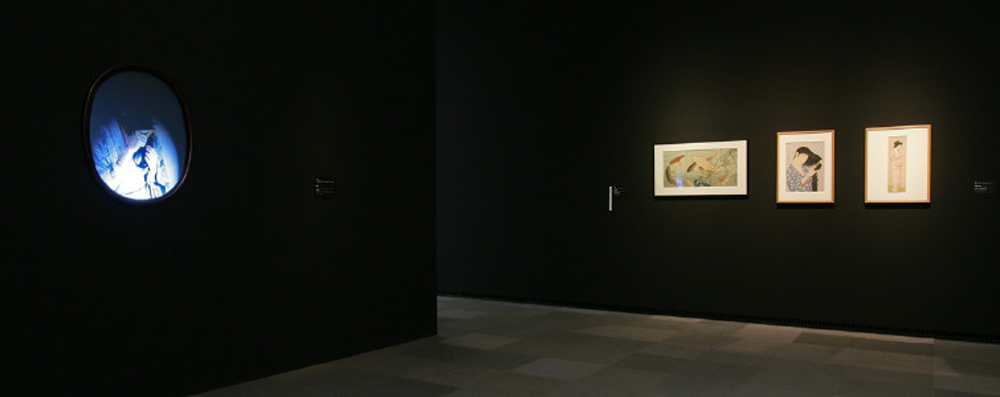
The installations that made the biggest impact on me were the 'moving paintings' of Mami Kosemura.  At the time, I could only describe my impression of her work but I have since discovered that Kosemura has uploaded low-res samples of her work onto the internet.  Although it is not as impactful to watch these 'moving paintings' via video-streaming as it is to see them in a gallery, it at least gives one an idea of what the  experience was like.  Before watching the videos, read my original post to understand their original context.  These stop motion animated shorts were not simply projected onto bare walls, but were projected onto specific spaces using furnishings that suggest a traditional Japanese house.

For the nature themed installations, Kosemura designed elaborate sets at her studio and shot the film frame-by-frame over a period of months.  For example, to create the third video below from the Flowering Plants of the Four Seasons series, Kosemura set up a 3 meter wide set and using a digital camera  shot a photo every hour for two months.  In the end, she had a total of 1,500 photos which she then edited to give them a painterly look.  This particular animation was projected onto a fusama for the Yokohama exhibition (see sample installation images at top of page).

Comb and Woman in the Mirror are also shot using a similar stop motion technique but  using actors and interior spaces.  These two installations are based on woodblock prints by Hashiguchi Goyo.  In addition to her work as an artist, Kosemura is a scholar of art history and her art is heavily influenced by her academic knowledge.  Read more about Comb and the techniques used in these installations in my review here.  To learn more about the Nihonga exhibition these works were a part of, see the links at the end of this post.

Flowering Plants of the Four Seasons (Shikigusabanazu, 2004-6)
 (3 videos)

Priming Water (Yobimizu, 2006)


Comb (Kushi, 2006)


Woman in the Mirror (Kyōdai no Onna, 2006)


To learn more about Kosemura, check out her homepage.


© Catherine Munroe Hotes 2011
Related Posts:
Nihonga 1: Fujii Rai
Nihonga 2: Matsui Fukuyo
Nihonga 3: Shiriagari Kotobuki
Nihonga 4: Nakamura Kengo
Nihonga 6: Nakagami Kiyoshi

Friday, November 12, 2010

The Legend of Kamui (カムイ 外伝 , 2009) in San Francisco

On November 19th at 7:15pm, The Red Lantern and VCinema will debut their joint movie screeening series with the 2009 Japanese film THE LEGEND OF KAMUI aka KAMUI GAIDEN, a live-action adaptation of the best-selling manga by Sampei Shirato. This is the West Coast premiere of the film.


Born a ninja. Die a ninja.


In 17th century Japan, disillusioned ninja Kamui finds himself on the run, in search of freedom. However, he discovers he's being hunted by members of his former clan who want to assassinate him for the clan secrets that he possesses. When he finally settles down in a small fishing village, Kamui finds himself face to face with an old nemesis whom he must deal with along with the ninja hunting party who are hot on his trail.


THE LEGEND OF KAMUI is a thrilling action movie starring some of the hottest talent in Japanese cinema today: Koyuki (THE LAST SAMURAI), Anna Tsuchiya (KAMIKAZE GIRLS), Suzuka Ohgoa and Japan Academy Award winner Kenichi Matsuyama (DETROIT METAL CITY, DEATH NOTE), (MEMOIRS OF A GEISHA). The film is directed by Yoichi Sai whose 2004 film BLOOD AND BONES garnered four Japan Academy Awards.

The film will be shown in Japanese with English subtitles.

Tickets will be $10 and will include a screening of the film as well as an post-movie reception with food and drinks and other goodies.

This event is open to the general public.

The Red Lantern is an Asian cinema meetup group located in the San Francisco Bay Area.

VCinema is an Asian cinema podcast also located in the San Francisco Bay Area.

Friday, October 29, 2010

Yokohama Art Navi (ヨコハマ・アートナビ)


Yokohama Art Navi’s Youtube Channel contains a mini-treasure trove of short alternative animation by young Japanese artists. The films were selected by renowned animator Koji Yamamura (see my reviews of Kafuka Inaka Isha, Atama Yama, and Man and Whale) and were all made within the last ten years. It’s an exciting video gallery of the best of rising animation talent in Japan. Many of these films have also been featured on the NHK program Digital Stadium.

Atsushi Wada’s Day of Nose (鼻の日/Hana no hi, 2005)


Ayaka Nakata’s Cornelis (コルネリス, 2008)


Saori Shiroki’s Evening Light (夜の灯/Yoru no Hi, 2005)


Ryo Ookawara’s Animal Dance (アニマルダンス, 2009)


Masaki Okuda, Ryo Ookawara, and Yutaro Ogawa’s Orchestra (2008)


Wataru Uekusa’s Chisato Stared (向ヶ丘千里はただ見つめていたのだった, 2009)


Masashi Yokota’s Ikuemi no Zanrou ( いくえみの残像, 2007)


Takeo Shinkai’s Mountain and Man (山と人/Yama to Hito, 2007)


Takashi Kurihara’s Happy Bogeys (2000)


Takahiro Hayakawa’s Kashikokimono (2004)


Hiroco Ichinose’s The Last Breakfast (かなしい朝ごはん/Kanashii Asa-gohan, 2006)


Shiho Hirayama’s Swimming (2008)


Wednesday, April 28, 2010

Iida City Kawamoto Kihachirō Puppet Museum  飯田市川本喜八郎人形美術館


 High on my list of places to visit the next time I’m in Japan is the Iida City Kawamoto Kihachirō Puppet Museum (飯田市川本喜八郎人形美術館) in southern Nagano Prefecture. 

The ningyō jōruri ( aka bunraku) puppetry has been performed in Iida City for over 300 years. During the Edo period, the town became famous for its two main schools of ningyō jōruri performance: the Kuroda Puppet Troupe (黒田人形座) and the Imada Puppet Troupe (今田人形座).

In honour of the International Year of the Child in 1979, Iida City inaugurated its first Puppetry Carnival Iida which assembled top puppetry performers from all over Japan. Now known as the Iida Puppet Festa, this annual festival attracts performers and audiences from all over the world and boasts up to 250 performances held in the span of just a few days.

In 1990, Kihachirō Kawamoto presented his animation films at the festival and received a very warm reception. This led Kawamoto to donate 200 of his puppets to the Puppet Museum and they now make up the core of the museum’s extensive puppet collection.

Most of the puppets on display are from the two elaborate historical dramas that Kawamoto did for the NHK: Romance of the Three Kingdoms (1982-84) and Historical Doll Spectacular: The Story of Heike (1993-94). Romance of the Three Kingdoms (人形劇三国志/Ningyō-geki Sangokushi) was a co-production with CCTV in China and was an adaptation of the epic Chinese tale of the same name. To get an idea of just how epic this puppet drama is, consider that each episode runs for 45 minutes and there are a total of sixty-eight episodes. The story was written by Luo Guanzhong in the 14th century and takes place during the turbulent final years of the Han Dynasty and the Three Kingdoms era of China (169-230A.D.)

Historical Doll Spectacular: The Story of Heike (人形歴史スペクタル平家物語/Ningyō Rekishi Supekutakuru: Heike Monogatari) was a similarly ambitious project but consists of a more modest forty-eight 20-minute episodes. This is also an adaptation of an epic tale. The Story of Heike centers on the struggle between the Taira and Minamoto clans for control of Japan during the Genpei War (1180-1185).

The collection is dominated by the puppets of these two epics because of the sheer number of puppets needed for the productions. However, the collection also includes the puppets used in his acclaimed short films. International audiences will be more familiar with the puppets from films such as House of Flames (1979), Briar Rose or The Sleeping Beauty (1990), and Dōjōji Temple (1976) and To Shoot Without Shooting (1988). Less familiar to audiences, but of equal interest are the puppets Kawamoto created early in his career making animated commercials and puppet storybooks for Shiba Productions. Unlike the dolls used in his film and television productions, these early puppets were not designed by Kawamoto himself. Shigeru Hijikata designed the puppets, Tadasu Iizawa was responsible for story writing, and Kawamoto crafted and animated them.

For those of us unable to get to this museum in the near future, the next best thing is Heibonsha’s publication, Kawamoto Kihachirō: kono inochi-aru mono (川本喜八郎 この命あるもの / Kawamoto Kihachirō: Puppets full of life, 2007). My copy came in the post yesterday and it is full of simply stunning photographs.

The book gives a complete history of Kawamoto’s career, starting with behind the scenes photographs from the making of The Book of the Dead (Shisha no sho, 2005) and moving backwards to his start as an assistant art director at Tōhō Studios in the late 1940s. The book features a complete filmography including the production credits for all of his films. There is also a photographic index of all the dolls on display at the Iida museum. The book is full of a wealth of information and a must-have for any Kawamoto fan.

Iida City, Nagano Prefecture
Motomachi 1-2
Tel: 0265 23 3594


Shisha no Sho / Puppet Show
Puppet Show
Ningyougeki Sangokushi Zenshu / Puppet Show
Puppet Show

© Catherine Munroe Hotes 2010

Saturday, March 27, 2010

Karel Zeman Exhibition in Kariya City


On his blog last month, Kōji Yamamura reported that he is helping Kariya City Art Museum in Aichi Prefecture set up their exhibition Another Czech Anime Master: Karel Zeman (チェコ・アニメもうひとりの巨匠 カレル・ゼマン展). Karel Zeman (1910-1989) was an acclaimed animation and special effects pioneer and this will be the first time that the Japanese public will have a chance to view Zeman’s puppets, storyboards, and original art in person. Go to Yamamura’s blog and click on the images to see amazing photographs of some of the original puppets as he unpacks them from their shipping crates. I recognize the  doll in the third photo as the neglected toy in The Christmas Dream (Vánocní sen, 1946), a film which won for best animation at the Cannes Film Festival and catapulted Zeman into worldwide recognition. 

The work of Karel Zeman is historically significant to Japanese art animation history because his work, along with others of the Czech puppet animation school, inspired Tadanari Okamoto (岡本忠成, 1932-1990) to go into puppet animation. I believe that Okamoto encountered Zeman’s work while studying at Nihon University. Like Zeman, Okamoto was an innovator with the materials he used to create his animated films.

This year marks the centenary of the birth of Zeman, who is particularly famous for his work combining stop motion with live actors. Yamamura seems to be planning to hold a talk and a workshop about the career of Zeman to coincide with this event. Keep an eye on his blog (Japanese only) for more information in the coming weeks. 

Earlier this week, Yamamura posted photographs of a scuba helmet used in The Fabulous World of Jules Verne (1958), which was an adaptation of Verne’s 1896 novel Facing the Flag (悪魔の発明).  As I won't be in Japan this spring, I do hope that Yamamura continues to post photos from this amazing exhibition.

The Karel Zeman exhibition runs from April 17th until May 30th. Screenings of Zeman’s films are also planned. Go to the announcement on Kariya City Art Museum’s website for more details and some more beautiful photographs of exhibits.

Kariya City Art Museum     
4-5 Sumiyoshi-cho,
Kariya City
Aichi 448-0852
Tel 0566-23-1636

〒448-0852 
愛知県刈谷市住吉町4丁目5番地 
TEL.0566-23-1636
FAX.0566-26-0511
bijyutsu@city.kariya.lg.jp

Monday, March 1, 2010

Mami Kosemura's Comb (櫛, 2006)


I first encountered the work of Mami Kosemura (小瀬村真美) at the Nihonga Painting: Six Provacative Artists exhibition in Yokohama in 2006. Both an academic scholar as well as an artist, Kosemura’s moving paintings are layered with references to art history and they open up many interesting questions about the relationship between art and reality.

Kosemura’s installation piece Comb (Kushi/櫛, 2006) is one of two pieces based upon famous works by shin hanga artist Goyō Hashiguchi (橋口五葉, 1880-1921). Hashiguchi is particularly famous for his bijinga (pictures of beautiful women) shown in very intimate situations: nude in the bath, a woman with her shoulder bared while applying make-up, a woman getting dressed. His work is valued not only for its beauty, but for its rarity. Hashiguchi made only 16 woodblock designs before his tragic early death from meningitis. 14 of the woodblocks and many copies of the prints were destroyed in the Great Kanto Earthquake two years after Hashiguchi’s death, making his work even rarer.

This animation installation is based on the woodblock print Woman Combing Her Hair (髪梳ける女, Kami Sukeru Onna, 1920). It depicts a beautiful, idealized woman combing her long, luxurious hair. She is dressed in a loose fitting yukata (cotton dressing gown) and appears serene and relaxed. The yukata is blue with a white sakura (cherry blossom) pattern with a red sash. There is a sensuousness to the woman’s pose and there is a voyeuristic element to the scene. The artist has given us an intimate glimpse into the minutiae of a woman’s daily personal grooming routine.

Mami Kosemura’s Comb gives a feminist interpretation of Woman Combing Her Hair. In the installation at Yokohama Museum of Art, the animation was installed in a wooden picture frame giving the effect of looking into a mirror reflection of the woman combing her hair (see a photograph of the installation here). The voyeurism of the original print is emphasized by the fact that in Kosemura’s Comb, we are only shown the bottom half of the woman’s face. She is rendered anonymous by a dark shadow cast over the top half of her face.

The positioning of the woman’s body mimics that of the original print, but some details have been slightly altered. The yukata has a more generic blue striped pattern, and the sash is pink. Although Kosemura has animated the woman to show the movement of her brushing her hair, the stop motion is not fluid but jerky. Kosemura’s technique is to take digital images of a posed model in costume recreating the Hashiguchi print. She then paints over the images and edits them on the computer. The resulting image looks like a moving painting. The effect is not to duplicate Hashiguchi’s print exactly, but to create a new work inspired by it. The end result looks less like a woodblock print and more like an oil painting in motion. Fine cracks have been overlaid on the image that create the effect of an aged painting. Unlike most Kosemura installations, this animation installation is silent.

Comb is a fascinating work that somehow manages to both make the subject more intimate while encouraging the spectator to view the piece with a critical eye. By animating the woman’s movement, Kosemura emphasizes the reality of the model. At the same time, the shadows over the woman’s face grant her anonymity and the jerkiness of the animation remind us that the woman is being interpreted by an artist’s hand.

Kosemura herself has described her methods as blurring the lines between ‘documentary’ and the ‘fictional’. In viewing a moving image, one has an impression of reality, but it has been mitigated by the painting and after effects added to the original footage. I’m not sure what she wrote originally in Japanese, as I could only find the English translation of her essay on her website, but it seems to me that the line Kosemura is blurring is between the photographed image and the painted image. Kosemura’s original image is not documentary because it has been posed, but the act of photographing her model brings her animated image closer to realistic movement than if she had drawn it. By using famous art as the basis for her animated installations, Kosemura is not only creating an original piece of art, but she is also offering up an interpretation of the art that inspired her own. The Yokohama exhibition also actively encouraged spectators to compare and contrast the works, renegotiating the spectator’s viewing experience of Hashiguchi’s print. There are so many layers to viewing an animation installation by Kosemura, with each work offering up fascinating new depths of interpretation of her unique animation techniques.

For more information about this artist, visit her websiteMIACA (Moving Image Archive of Contemporary Art), or the Yuka Sasahara Gallery.

Shinshaku Yotsuya Kaidan / Japanese Movie
Japanese Movie

© Catherine Munroe Hotes 2010

Thursday, June 25, 2009

Walking in my Mind


The Hayward Gallery in central London is currently hosting an exhibition of artists whose work “explores the inner working of the artist's imagination through dramatic, large-scale installation art.”

Walking in My Mind features the work of ten international artists. It uses both indoor and outdoor spaces, with each sculptured space representing the individual mindscape of a different artist. One important theme is the blurring of boundaries between inner and outer space.

The exhibition has been co-curated by Mami Kataoka who works as a senior curator at the Mori Art Museum in Tokyo. Kataoka’s presence has ensured that three exciting Japanese artists: Yayoi Kusama, Yoshimoto Nara, and Chiharu Shiota.

Yayoi Kusama (草間彌生, b.1929)

The oldest artist in the exhibition and probably the most internationally recognized of the ten. Kusama’s work demonstrates her obsession with pattern (particularly polka dots), repetition, and accumulation. Her work has been associated with surrealism, l’art brut, and abstract expressionism. Kusama suffered severe trauma as a child and as an adult has struggled with mental health issues. These struggles are an inextricable part of her art, which to me has always demonstrated how in the souls of even the most troubled one can find things of indescribable beauty. Kusama’s work has been used in the poster art for the event (see above).


Yoshimoto Nara (奈良美智, b. 1959)

As an artist, Nara came to international recognition as a part of the 1990s J-pop art movement. Like Kusama, Nara has a minimalist aesthetic, but underneath his seemingly harmless subject matter (cute children and animals drawn or sculpted in a manga-influenced manner) lies some disturbing elements. For example, often the children have nasty expressions on their faces. At other times, there is something disturbing lurking somewhere else in the painting, drawing, or sculpture. Despite the sometimes spooky nature of his art, there is something quite magnetic about it that captures one’s attention.


Chiharu Shiota (塩田千春, b. 1972)

This young Kansai artist has a nightmarish element to her art which reminds me of the work of Fuyuko Matsui (松井冬子). Although the two women are working in two very different artistic aesthetics (Nihonga vs. modern art), both of their work succeeds in being both spellbinding and giving me a chill up my spine with its deeply macabre nature. Themes in Shiota’s work include entanglement, binding, and entrapment. I particularly enjoy the architectural elements to her installation work. Shiota has an extensive gallery of photographs of her work on her official website.

For more about this exhibit, see the Guardian’s video review of the event, or go to the Hayward’s website.

Saturday, April 19, 2008

Kusama: Princess of Polka Dots


American experimental and documentary filmmaker Heather Lenz is currently in production with a documentary on the life and career of Yayoi Kusama (草間彌生). According to the official website for the film, the debut of the film will coincide with the retrospective planned by the Film Arts Foundation in celebration of Kusama's 80th birthday in 2009. The retrospective, Yayoi Kusama: An Odyssey will travel to at least four venues in the States and Europe, though the venues have not yet been announced.

Kusama’s art is shaped by her long struggle with mental illness. She herself claims that her famous polka dot motif comes from her hallucinations and dreams. Ever since I encountered the Collection de l’Art Brut in Lausanne, Switzerland a decade ago, I have been fascinated by l’art brut (literally ‘rough art’, it usually means self-taught artists removed from mainstream art or mentally ill artists). Often l’art brut has a loneliness or deep melancholy about it, which can be very depressing. What makes Yayoi Kusama’s art so unique, is that her obsessions and experience with mental illness expresses itself in colourful art, that I actually find quite uplifting.

Kusama made a name for herself in1960s New York City. A friend to Andy Warhol, and other avant-garde artists of the times, she organized weird and wonderful mass events, known as ‘Kusama Happenings”, in places like Central Park and the Brooklyn Bridge, often in protest against the war in Vietnam. As an artist, she has dabbled in painting, sculpture, installations, performance art, fashion design, poetry, novels, and experimental films.

I am really excited at how this documentary about Kusama’s life and art will turn out. It looks as if it will take a feminist approach to Kusama’s struggles with mental illness and her career as an eccentric artist. The producers and project advisors are all women, and the promotional clip features a variety of women speaking about Kusama’s relationship with her art.


As a side note, when I went to the website of Lausanne’s Collection de l’Art Brut in order to make the hyperlink for this article, I noticed that they are featuring a special exhibition on Japanese l’art brut until September 28th. What a coincidence! The exhibition features twelve self-taught artists including Shinichi Sawada, Satoshi Nishikawa, Mitsuteru Ishino, Hidenori Motooka, Masao Obata, Yuji Tsuji, Takashi Shuji, Takanori Herai, Toshimitsu Tomizuka, Eijiro Miyama, Tohshiaki Yoshikawa, and Moriya Kishaba. They have also produced a catalogue and a DVD for purchase at the museum.

A travelling exhibition, called Crossing Spirit, is currently touring Japan and will be at the Borderless Art Museum (NO-MA) in Omihachiman until May, followed by the Shiodome Museum in Tokyo until July.

Monday, April 14, 2008

Neo Tokyo3


While I was in Frankfurt for Nippon Connection, I took some time out from the screenings to see the Neo Tokyo3 exhibit at the Deutsches Architekturmuseum. It is right next door to the Deutsches Filmmuseum, where I saw their corresponding exhibit Anime! High Art – Pop Culture last month.

On the main floor, the Architecture Museum features some amazing photographs of German theatres that were taken before the second World War. They also have a remarkable exhibit of models that recreate towns and villages from a wide range of historical eras, from London’s Crystal Palace as it looked in 1851 to the Forum in Pompeii. Although the museum may look very posh from the outside, it is actually a very inviting place with Lego play stations for kids to build their own architectural marvels while their parents take their time examining the art on display.

One must climb all the way to the top floor (the elevator was a bit hidden) for the Neo Tokyo3: Architeture in Manga and Anime exhibition which runs until June 8th of this year. The exhibition gets its name from the futuristic cities in the Akira (1982) manga and the Neon Genesis Evangelion (1995) anime. Neo Tokyo + Tokyo3 = Neo Tokyo3. Apparently Akira was the first manga series published in full in Germany. The curators claimed that the urban structures in manga evoke a certain kind of mood in the reader which affects both the protagonists of the manga and the framework of the storyline.

One section of the exhibit featured sculptures, drawings and photographs from a wide range of international artists including Kenzo Tange, Kishi Kurokawa, Ron Herron, Ettore Sottsass, Raimund Abraham, Walter Jonas, and Peter Cook. This section of the exhibition outlined the Metabolist movement, which was established at the World Design Conference in Tokyo in 1960. The Metabolists, a group of architects, theorists, and designers, were reacting against modernism and the architecture of the 1950s and they were proponents of an architecture style that became known as Megastructures. The main argument of the exhibit seemed to be about the influence of the Metabolist movement on architecture in manga and anime. Some of the designs featured had been directly recreated in manga, while others provided inspiration for manga architecture.

Something that I learned from the exhibit was that manga publishers hire trained architectural draughtsmen and engineers to assist with the development of futuristic cityscapes in manga. There were a few examples of sketches done by architects during the planning stages of manga that were remarkable for their attention to detail. In the draughtsman section of the exhibit, the museum had made available a wide range of manga and related books for visitors to browse including Clamp X, Akira, Evangelion, and a wonderful Japanese-language art book about the making of Rintaro’s Metropolis that I really must get a hold of. I actually had thought that the exhibit would feature more about the influence of Fritz Lang’s Metropolis on anime and manga, as it would have been an obvious point of contact between German and Japanese culture, but the focus was more on the international impact of Japanese architectural designs.

Accompanying the exhibition was a booklet containing an essay by two German academics and the curator (all architecture specialists) in German and English that covers all the theoretical ground of the exhibition. It includes black and white images of some of the art on display. It is a limited edition publication and unfortunately not available to buy on amazon.de. Try contacting the museum directly.


AKIRA - DTS / Animation


© Catherine Munroe Hotes 2008

Thursday, March 13, 2008

Anime! High Art - Pop Culture


I had the opportunity this week to check out the Anime! High Art – Pop Culture exhibition at the Deutsches Filmmuseum in Frankfurt am Main. The exhibition has been timed perfectly to coincide with Nippon Connection next month as well as Neo Tokyo3: Architecture in Manga and Anime running next door at the Deutsches Architekturmuseum (until June 8th).


The exhibition is broken into six main sections: Children’s Anime, Shōjo Anime, Erotic Anime, Shōnen Anime, Amano Yoshitaka’s art, and Futuristic Visions (mechas, AI, and 3D). The exhibits consist mainly of sketches (genga), drawings (dōga), and cels from anime, as well as clips from the featured anime playing on screens throughout the exhibition. The lobby also features a display of figurines and other memorabilia.


The first section was particularly informative for me. I had not realized that many of the old cartoons that my husband and his friends grew up with in Germany in the 1970s were actually animated in Japan. Wickie und die Starken Männer (Chiisana baikingu Bikke, 1974) and Die Biene Maja (Mitsubachi Maya no boken, 1975) don’t have the typical ‘anime’ look about them and I always presumed that they were designed in Europe. Heidi, Girl of the Alps has what I call an ‘anime’ look: kawaii characters with big round eyes. I had always thought that these projects were conceived in Japan and then sent around the world for dubbing, but it turns out that international co-productions were more extensive than I had realized. European broadcasters, particularly ZDF in West Germany, sought out co-productions with Japanese animators in order to keep costs down. The character design and story for Biene Maja was initiated in Germany, but animated in Japan with some contributions from animators at Warner Brothers. The most interesting evidence of this were the drawings with notes written on them in English and Japanese. The resulting series is actually a West Germany-Austria-USA-Japan co-production.


The next three sections of Anime! High Art – Pop Culture give an overview of some of the sub-genres of anime, with nods along the way to Studio Ghibli and Osamu Tezuka. The section on Amano Yoshitaka features twelve paintings that feature off-centre details from anime characters, with particular emphasis on the eyes. His large mural Universe (lacquer on aluminum, 2002) is most impressive and requires quite a bit of time to take in all the details on it. The final section looks at the futuristic genres in anime and ponders whether or not there is a future for 3D animation in Japan. So far, the Japanese seem to prefer using 2D animation for reasons that range from financial (cheap to make) to the aesthetic (a cultural tradition of ‘flat’ aesthetic).

I am not sure why the title of the exhibition puts high art before pop culture, because the only section that could be considered high art are the paintings and the mural by Amano. If I had any criticism to make of the curatorial choices, I would suggest the inclusion of more ‘high art’ for one to compare and contrast with Amano’s work. Amano, like so many Japanese animators, has one foot in the popular culture scene and another in the world of high art. He is most famous for his design work for the Final Fantasy computer games and popular anime like the Gatchaman series and Tekkaman.

The best part about the exhibit is the book Ga-Netchū! Das Manga Anime Syndrom that they commissioned to complement the ideas raised by the selection of art they selected. The book features essays from a wide selection of authors written in German or translated from Japanese or English to German. As the exhibit will be moving to the States later this year, it seems likely that the book will also be translated to English at some point. The book features a lot more art than was in the museum. I was pleased to see the inclusion of a short piece by quirky manga artist and animator Shiriagari Kotobuki whose work I have reviewed before on this blog.


Anime! High Art – Pop Culture runs at the Filmmuseum until August 3rd. It will head to the Louisiana Museum of Modern Art this autumn (October 8th, 2008 – February 22nd, 2009) followed by a stint at the Academy of Motion Picture Arts and Sciences next year (May-August 2009).


© Catherine Munroe Hotes 2008